powered by

Tender Writing – HELP! I need somebody – HELP! not just anybody

Tender Writing – HELP! I need somebody – HELP! Not just anybody

HELP! I need somebody – HELP! not just anybody

The number one mechanism that puts off business leaders and development executives from getting help with bidding for work- is the sheer prices that many consultants charge for their expertise and support. We all have received that email from some portal, inviting you to attend ‘Bid Writing Masterclasses’ in a swanky conference suite, usually a million miles away for around £100 per ticket per day.

There was nearly £171 Billion spent within the UK’s public procurement sector in the last year alone. Why should companies pay for help in order to access this money? Who wants to pay over the odds for some helpful guidance? – especially when there are various options available … FOR FREE!

Tender VLE

In May 2018, we will be launching Tender VLE, a highly innovative virtual learning environment (VLE), where we will be sharing regular masterclass videos across a diverse range of procurement topics, including support and guidance around tender readiness, bid management and pretty much every procurement practice you can think of. This will be broken into various knowledge strands so that people with the most limited knowledge and those with advanced knowledge can receive the best help and guidance to succeed. The best part of all this – is that it comes at no cost to the learner/viewer. All videos will be made publically available on our VLE and onto the likes of YouTube, allowing unlimited access to ALL.

Tender Consultants

Additional to this online support, another one of our business development platforms, Tender Consultants, works with you on a more personal level to ensure a helping hand is always there when needed. Currently, procurement is far from being easy. Our mission is to de-complicate the sector so it remains simple for all buyers and suppliers across the country. Our firm is different from other consultancies, as we offer free impartial advice on your procurement strategy. Subsequent to our advice, you can then decide what kind of support you need. Whether this be our Tender Readiness Assessment? Tender Writing Service? and/or Guide and Reviews? etc. All services on offer are accustomed to your needs, meaning we do not overcharge or maintain bulk rates. We offer more than affordable consultancy rates that remain specific to your requirements and will only enhance your chances of winning.

Our upcoming Tender Bank system, launching within the next year, will also provide customers with a one-stop-shop for all of their tender needs, including templates, pre-established responses that are tailored to your sector and varying policies.

In the meantime, we are happy to provide whatever support you need. Contact us for free advice and consultations on your tendering efforts. Let’s get you some of that £171 Billion up for grabs! Don’t just use anybody – use the right body! Use Hudson Procurement Group!

Believe you can and you WILL, Believe you can’t and you WON’T

Believe you can and you WILL, Believe you can’t and you WON’T

You know what they say – believers are achievers!

Corny I know, but the principle DOES apply when tender writing. You can never just hit it and hope for the best – this isn’t snooker! Each piece of work you bid for should have been accurately assessed to make sure this is a good opportunity for your business (see our ‘to bid or not to bid’ blog for further information).

The point is, you have to go in fully prepped with the clear mindset of achieving this piece of work. If you are not fully confident that you can win the work, then don’t bid for it. Simple.

If you feel you are in with a good shot – then make sure any doubts or reservations are left at the door, as you don’t want these to be identified by the evaluator.

Remember to be descriptive, be assertive, but most importantly be positive!

You should:

  • use phrases like ‘We will …’ – no one cares you if you are attempting to do something – this is your piece of work – be confident and state you WILL deliver all that’s expected;
  • demonstrate your willingness to adapt, conform and collaborate with the buyer – always demonstrate further added value and what more you can do for the buyer – think of the positive effects this has socially and economically;
  • validate your company – describe not only what makes you different, but what makes you BETTER? Explain clearly why the buyer should choose you and not your competitors – why do YOU stand out?

You’ll find that if you’re below 80% sure to whether or not you should bid for the contract – this tends to show less confidence on paper. The better the opportunity that is right for you, the better your proposal will be projected. Unbeknownst to many, on a subconscious level, if we believe we are NOT destined to win the work, we will in many ways lag behind our competitors in that all-important tender.

Never go for any opportunity! Always go for the ones you believe in!

Get in touch with our bid writers today. We can help you believe what’s best for you!

Why Choose Hudson Procurement Group?

 Why Choose Hudson Procurement Group?

  • What do you do exactly?
  • How does it all work?
  • Why should I choose you?

Although these questions are being asked less and less due to our growing presence online and current position in the procurement sector. We still want to show you some key traits of our provision and how we work FOR YOU!

We have recognised that across all businesses nationally, contract/tender opportunities are spread so wide that it takes time and unnecessary hassle to source the right prospects for your company. Even if the right ones come through from your many subscriptions on a range of procurement portals, this may be delayed by up to 5-10 days, along with some (if not all) opportunities having zero relevance to your organisation. This is because CPV codes* are being used incorrectly on a major scale by both buyers and suppliers. Some portals don’t offer the full range of CPV codes available and/or delay the release of key opportunities due to automatic processes.

*CPV (Common Procurement Vocabulary) Codes are used to differentiate, segment and classify contract opportunities so that your company can search and receive notifications about the opportunities aligned to your provision/offering.

With over 25 years’ experience and extensive knowledge of tender management and opportunity tracking, the creative and innovative specialists at Hudson Procurement Group is doing something that no other company is doing. We are MANUALLY tracking all opportunities that are released daily from the majority of procurement portals across the UK. We take this information to MANUALLY publish daily bulletins that are not only sector-specific, but specific to your actual service. We do not rely on CPV codes, which ensures no mistake, or irrelevant opportunity will ever be sent. Every opportunity posted by public AND private buyers will be provided to you promptly, clearly and consistently on a specific platform dedicated to your sector.

We currently operate 11 industry-specific platforms including:

We offer free demos with a dedicated Account Manager, who also provides live support with our platforms. However, due to the intuitive and user-friendly design, we guarantee minimal support needed.

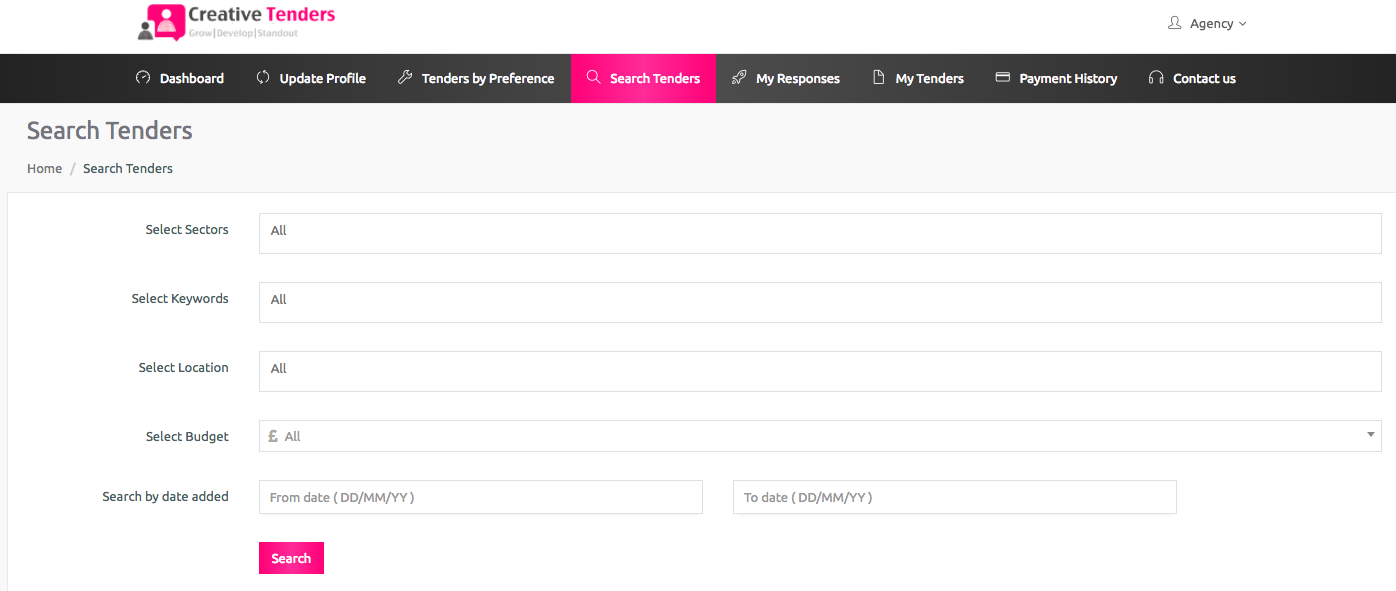
screenshot of creative tenders portal

Customers are guaranteed to have every opportunity at their fingertips, including the value, location and brief description to what’s required. Their procurement practices are effectively improved, eliminating excess time spent on sourcing opportunities and more time on developing their procurement strategies.

However, it doesn’t stop there! Due to our combined knowledge and experience, we also offer Tender Consultancy.This platform supports clients to better understand and maximise procurement practices within their organisation. This includes impartial advice, bid writing, tender training, tender reviews and holistic support with procurement.

We have upcoming systems to support clients EVEN FURTHER in the upcoming years, which include:

Tender VLE

A virtual learning environment dedicated to offering FREE tender and procurement training on a range of educational levels (beginner, intermediate & advanced etc.) all in VIDEO & BLOG format;

Hudson Discover

A one-stop-shop for buyers and suppliers to use an inter-trading platform. This is to identify buying opportunities for our group of subscribers, making our portals more specific to the needs of our customers. This is already in development as per our ways of working above;

Tender Bank

An online platform where customers can obtain multiple documents that will support their tendering efforts, including policies, matrices, methodology templates and written response templates in line with sector-specific objectives;

Procure Smart

A user-friendly collaborative platform for buyers and suppliers where they will be able to upload, communicate and submit tender documents online.

 We are Hudson Procurement Group and we are here to ensure we help suppliers, buyers and the overall economy. We want to maintain access to procurement best practices and most importantly GROW, DEVELOP & STANDOUT!

Why choose Hudson Procurement Group? – I think by now you already know!

New Facebook Business Update – How this affects you?

New Facebook Business Update – How this affects you?

Can you hear that?

That’s the sound of creative agencies everywhere gasping at the recent news that Mark Zuckerberg wants to make Facebook’s news feed more ‘meaningful’ and ‘personal’.

One of Facebook’s biggest “focus areas for 2018 is making sure the time we all spend on Facebook is time well spent.”

This is the opening line in Mark’s latest monologue, posted on 11th January, where he states that consumer research has led them to the realisation “that public content — posts from businesses, brands and media — is crowding out the personal moments that lead us to connect more with each other”.

With changes already underway as of last year, Mark has promised all Facebook users that within a few months’ time “you can expect to see more from your friends, family and groups’ and seeing “less public content like posts from businesses, brands, and media”.

Apparently, this research has resulted from various studies carried out, including that on mental health and social media, in which Mark states “when we use social media to connect with people we care about, it can be good for our well-being […] we can feel more connected and less lonely, and that correlates with long-term measures of happiness and health.”

Facebook Business

So, how will you be affected?

The Creative Industry will undoubtedly be hit the hardest, due to many core services being the management of Social Media. Of course, we still have the likes of Twitter, LinkedIn, Instagram, Pinterest and Snapchat. But Facebook, as many will know, is key into retaining new customers and serves a great platform for consumer interactivity. With less and less engagement toward Facebook by the end of 2018, is this the beginning of the end for Facebook targeted ads? Or are prices going to seriously rise in order to pull your content through to your engaged audience? This will become increasingly limited over the next few months!

Although millions of pounds have been spent by companies since Facebook’s ‘target ads’ launched have begun, it seems there will be a massive drop in the amount being spent to garner consumer and business leads through this platform going forward.

Thinking ahead…

Bad news for some businesses and consumers who don’t mind receiving the odd advertisement now and again. Engagement between businesses and audiences will be reaching an eventual all-time low by the end of the year. Mark warns us that time spent on the platform and “some measures of engagement will go down.”

It’s time to get your experts to think ahead on ways in which B2C and B2B engagement can be driven elsewhere. Make sure your strategies for both yourselves and your clients consider this vital update. Facebook goes “from focusing on helping [consumers] find relevant content, to helping [them] have more meaningful social interactions.

John Hudson – In Conversation With (Creative Tenders)

John Hudson – In Conversation With (Creative Tenders)

Why do you think Creative Tenders was an instant success?

For me the answer is simple.  We created a platform specific to the creative sector that was easy to use, wasn’t complicated like most platforms on the market and we ensured that the product does what it says on the tin.

As a business, we know how to communicate to creatives due to our sector knowledge which helped us to understand the pain points when tendering in the sector and how we should work towards minimising these through the effect build of the product.

What do you see changing in the world of procurement over the next 3 years?

More opportunities for SMEs.  The government have announced they will spend £1 in every £3 with SMEs by 2020. Coming down from £1 in every £5 which is the current standard.  An approximate £15billion will be spent annually with SMEs either directly or through the supply chain.

For this to happen I believe government need to strongly address how they buy and the scoring systems they put in place for purchase to ensure fair procurement processes with a reduction on ‘free pitching’ which is a major bug bear of directors here at Creative Tenders.

What’s your thoughts on the current procurement practices for our government?

Procurement has improved a lot since we started tendering but they still have a very long way to go.  We’re seeing a lot less handshakes and more open procurement processes with sufficient feedback for agencies to improve their tendering next time round. However, we’re still seeing horror stories and wasted pitching which needs to stop.

Feedback is business critical for agencies who tender.  They need to be able to improve to ensure tendering is a viable route to market, so we’re spending some time working with government procurement departments to fly the flag for the sector and to make sure we’re heard as a united voice.

What is your hope for the UKs creative sector?

I hope that we become the world leaders for setting creative design trends, which I believe we’re extremely strong, and that our UK businesses look Internationally for their work.  The perception of the UK design capabilities is fantastic, the US love British design so let’s embrace that and start growing our client base outside of the UK.

You’ve chosen Boston as your first US office, why is this?

Massachusetts is the closest state to the UK, so logistically it is the easiest for our commute.  We’ll need to be in the US a lot over the first 24 months so we need to think about ease of travelling and distance to New York.  We’ve recently attended Inbound in Boston, Hubspot’s event, which has a fantastic community and 20,000 businesses gather to hear what’s new in the world of inbound marketing.

America will be a challenge as there is a lot less structure in America when it comes to procurement, but our product will provide businesses with the much needed process to carefully and correctly select its suppliers.

What’s the future for Creative Tenders?

Creative Tenders has a 15-year business plan.  This business plan evolves every 3 months during our management meeting, but the core goals remain the same, just the delivery behind them evolves as technology and external factors evolve.

First, we’ll crack America and ensure the products we develop for our customers are built with the customer in mind, ensuring our core goal of growing the UKs creative sector remains at the forefront of what we do.

What can agencies expect when working with Creative Tenders?

Great customer service and a product which is easy to use that benefits our buyers.  After attending Inbound and meeting many of the world leading SaaS businesses we believe America leads the way with regards to customer service.  I know it’s a real cliché but I genuinely feel this is how we gain loyalty from our customers.

If you could explain Creative Tenders in 3 words what would you say?

Effective, simple, approachable.


Creative Tenders ‘In Conversation with Jill Hudson’ – Creative Tenders Website

‘In Conversation with Jill Hudson’ –  The founder of the Creative Tenders website

What is your role at Creative Tenders?

My role is quite vast, on a weekly basis I work with agencies who are struggling to see results from their tendering efforts, delivering tender training and tender writing services, as well as driving forward product innovation to ensure our group of businesses are constantly developing.

Why you think the Creative Tenders website was an instant success.

Creative Tenders was our flagship product and I thought about this business whist working in agencies and often thinking ‘there has got to be an easier way to get this information’.  I knew that if I had this trouble thousands of others would too, so I wrote a technical specification for a product which would make my job easier.

Because I knew the industry so well, having worked in it for over 15 years that the product instantly screamed success.  On the day we launched the ‘coming soon’ campaigns the phone literally rang off the hook.  We had 5 staff at the time and they were all on the phone taking calls.  As all phone lines were busy other agencies were messaging us on Facebook and email saying they couldn’t get through and wanted to speak about the product as soon as possible.  I knew then that this product would be a success.

Then when we launched, within minutes’ agencies were signing up.

What do you see changing in the world of procurement over the next 3 years?

Procurement is changing but slowly. With the growing use of technology and technical capabilities procurement portals will hopefully become more user friendly.  Most portals, in my opinion need simplifying to make it easier for agencies to navigate.  I think this is starting to get better for digital agencies with the use of Digital Market Place.

Brexit will play a huge role in procurement changes, even those who don’t realise it, a lot of money spent on creative tendering opportunities has come from Europe, either directly or indirectly so we won’t see any more opportunities which are funded by ERDF or ESF for example.  I believe it will take a while to steady the ship once we leave the EU, so I am hoping and praying that the transition won’t affect SMEs too much.

Lastly, the government plan on spending £1 in every £3 with an SME by 2020, they currently spend £1 in over £5 either directly or through a supply chain. It will be interesting to see the impact Brexit has on this goal.

What’s your thoughts on the current procurement practices of our government?

It’s quite clear that it isn’t 100% right, nor do I believe that the government think it is.  I know it’s very frustrating for our customers that they need to register on many different portals to access tender documents, each system with a completely different interface and user requirements. I won’t be the first to say that this needs to be addressed to move forward procurement in general.

Having tendered for over 15 years, I see the frustrations of our customers and have personally seen some horror stories in regards to client selection processes but all we can do is unite and work with procurement departments to educate them on how much effort we put into our tender documents to ensure fair procurement practices are addressed.

What is your hope for the UKs creative sector?

The sector is flying, there is no doubt about that.  We want our agencies to feel confident stepping outside of their comfort zone and looking at International business.  We’re opening our US office in 2018 to support and encourage buyers to use our UK based creative agencies.  This will be a core focus for us during 2018 and any interested agencies should contact me direct so we can chat about how we will support agencies with this development.

You’ve chosen Boston as your first US office, why is this?

There is a number of reasons really, firstly it’s the shortest flight from the UK now that they’ve opened direct flights from the North, it is also only a short 50-minute flight from New York.  Secondly, we’ve visited Boston attending conferences, events, hosted meetings with businesses and government bodies and we feel the support on offer and the welcoming nature of the business community, that Boston is ideal for us to dip our toe in the water and start making some waves in the US.

What’s the future for the Creative Tenders Website?

The sky’s limit. No really. We’ve made significant progress in the year and a half we’ve been in business. I dare say 90% of all UK agencies know who we are, we have over 500 customers which grows daily and we have an exceptional retention rate for agencies choosing to stay with us year on year.  Now that we’ve launched another 9-sector specific tender portals, we’re working on Hudson Discover which is an online inter-trading portal, allowing businesses to buy and supply directly to one another from our system.

The next 12 months sees us focusing on opening the US office, launching Tender Bank to support agencies through simplifying tendering, ensure Hudson Discover is up and running and operating successfully and generally working hard to double the number of tenders we upload daily.  We’re currently uploading about 10-30 every day, we want to make that a minimum of 50 new opportunities every single day by the end of 2018.

What can agencies expect when working with Creative Tenders?

Consistency.  We will ensure you get your daily bulletins so you don’t miss any opportunities.  We will guarantee that if you log a support query someone will call within 1 working hour maximum, and we ensure our customers that we are constantly flying the flag for the creative sector and encouraging fair procurement practices.

We won’t become stale either, we are constantly in development and constantly generating new products that benefit UK agencies during their tendering journey.

If you could explain Creative Tenders in one sentence what would you say?

An innovative product that ensures timesaving for busy agencies, making it a business-critical tool for agency growth.


Why choose Creative Tenders?

Why choose Creative Tenders?

Mr Tenders vs Mrs Finder

Our system is used by two types of customers, creative agencies and freelancers looking for new business opportunities. Business owners and marketing managers looking to source creative partners will also benefit from Creative Tenders.

How can we help your business grow you might ask? By using Creative Tenders (for agencies and freelancers) or by using Creative Finder (to source creative partners).

Here’s how….

Mr Tenders vs Mrs Finder

Mr Tenders will…


  • Source creative only tenders, minimising the time needed to search for tenders
  • Work with his team who has decades of creative sector experience
  • Provide a time saving solution for business development teams
  • Provide a dedicated account manager to make sure you don’t miss out
  • Set up cold calling campaigns to generate unique opportunities for our subscribers
  • Grow his team who are currently operating UK wide with a clear international strategy
  • Create an ideal solution that works for both growing UK agencies and freelancers


Mrs Finder will…


  • Give you access to our ‘free to use’ system for unlimited invitation to quotes
  • Help you write your creative and digital specifications
  • Ensure your opportunities are seen by hundreds of relevant freelancers and agencies
  • Take the legwork out of securing competitive quotes
  • Ensure our system is an easy to use online solution
  • Allow agencies to respond via our system, reducing the amount of emails you receive
  • Provide you with a dedicated account manager with over 10 years’ industry experience

Don’t waste your valuable time searching for tender opportunities and suppliers….we’ve got them all in one place.  Sign up today at www.creativetenders.co.uk

Tel: 0203 051 2217


Top Ten Tips for submitting a tender

Top Ten Tips for submitting a tender

Here are our top ten tips for completing a tender document:

  1. Read the whole tender, even if it is 100 pages long. Page 82 may have a vital bit of information about how to respond to the tender.
  2. Adhere to the specific tendering rules and regulations. If they want the tender in Ariel point 12, complete the tender in Ariel point 12.
  3. Ask a question if something’s not clear. Don’t just assume it’s a silly question.
  4. Answer with the information they have requested, not with the information you think they should know.
  5. Follow the format they’ve requested – they are requesting it that way for a reason and make it as easy as possible to find the information they’ve requested, creative design is great, but ensure it’s in a readable format that flows.
  6. Understand how they will be marking your tender, the percentages are hugely relevant to where you should be concentrating your efforts.
  7. Show consistency in your tendering processes and procedures – don’t contradict yourself from one section to the next.
  8. Don’t use standard, over complicated content. Those marking the tender will know if you’ve cut and pasted your company biography from your website.
  9. Choose either 1st person or 3rd person and don’t mix it up. Don’t make it difficult for the reader to follow.
  10. Proof read your response more than once, and get another member of your team to double check for spelling and grammatical mistakes.


Top five reasons for tendering

Top five reasons for tendering


We’re often told by companies that we work with, that they don’t tender as it takes too long, they’re never successful, they don’t have the time…etc. etc.

Tendering is a powerful way to generate new business, so powerful in fact that many businesses use this as their sole route to winning new business. We think every business should at least try tendering.

We understand why businesses are put off from the long, in-depth process you have to follow. But, spending the time upfront to learn how to tender could be vital to the success and growth of your service based business.

Our Growth Director, Jill has been winning work via bid writing for well over a decade, and she is sharing with you below, her top five reasons for tendering in creative and digital agencies.

1. You don’t need to sell the need for your service

Responding to tenders means businesses have already established the need for your services and have allocated a budget to carry out the work.  This reduces the need for selling the benefits of the services, and establishing the benefit of investing in XYZ.

Responding to a tender means you’ve just got to prove that you’re the best fit for their business.  Surely it’s worth a try? Just make sure you follow a strict process of what you will and won’t apply for.

2. The project has clear start and end dates

When tendering the client usually outlines when they would like the work to start and end, meaning you can work your studio time around this.  When selling directly B2B we often have projects on hold waiting for content / imagery etc. We’re not saying this won’t happen with tendering, but your client is likely to be more prepared.

3. Budget signed off in advance

As the budget has already been allocated, you know what constraints you’re working within, allowing you to best advise your client where to allocate spend.

4. Clarifies your offering to clients

You won’t always be successful when tendering, but completing a tender document often gives you additional clarity on other areas of your business. It also teaches you how you can productise service offerings.  It also allows you to benchmark your fees against what people expect to pay.

5. Research

Tendering allows you to see how businesses are spending their marketing budgets.  This helps you to better understand where you should be spending your own marketing budgets and what services are the most popular.  If you see an influx of social media tenders and this is an offering your business provides, read the Invitation to Tender documents. You should then align your service descriptions to ensure it is suitable for the market you’re selling into.


Your 12 months’ commitment

Your 12 months’ commitment.

We’re often asked by companies who are interested in our system why we ask for a 12 months’ subscription.  There are multiple reasons for this so I thought I would sum it up in a quick blog.

First and foremost, we believe that in order to get a true reflection of any business development activities you have to give it a decent run.  All of us who have been through the tendering process know the in-depth process of sourcing potential opportunities, responding by the deadline provided and waiting whilst the decision is made on the successful provider.

By giving monthly access to the system, we’re saying that we expect our businesses to start winning work immediately and they will find the perfect opportunity for their business on day one.  We can’t and we don’t make that promise.  Every business is different, and every business has different requirements of what they’re looking for and industries in which they want to work.

It is also industry standard to commit to 12-months subscription for this very reason.  It’s to give you a decent run at seeing a good return on investment.  Also this gives us a chance to work with you as an outsourced business development partner.

We’re very open on our website, with lots of ways to get in touch, and we encourage people to get in touch to see a live demo of the system. This allows you to see the types of creative contracts in the UK we have on our system. For ease we have supplied examples of past tenders across various creative sub sectors which include:

When people have signed up, we contact them after their first month to ask how they wish to be account managed.  Some clients like to be emailed every single time a suitable tender comes onto the system. However, others prefer to use the system alone and be contacted once a month to check everything is ok.  We’re happy if you’re happy.

We’re always happy to stay in touch…

Our subscribers are informed on day one of sign up, who their account manager is and their contact details for getting in touch.  We’re only ever a phone call away Monday-Friday 9-5, and you’re always likely to get a response out of hours as our team are very keen on developing positive relationships.

Once you’ve been introduced to your account manager, they will ask several questions about the type of work you’re looking for.  This information is shared in our weekly sales meetings which gives the Creative Finder sales team a brief of what types of opportunities you want to see on our system.  We’re so much more than a technology platform, so asking people to commit to 12-months’ is essential for us to see a return on the time we invest into our customers.  As business owners we know you will understand this concept.

We’ve so many happy customers in just the short 3 months we’ve been live, we save agencies so much time by searching over 1,000 websites every single day to source new tenders. With our Creative Finder sales team, we know given the period of time we’re asking you to commit, that we can help you grow and play a part in your proactive business development activities.

Our founders John and Jill are always happy to answer any questions our customers or prospective customers have about our services. Please don’t hesitate to contact them anytime on their direct email addresses john@creativetenders.co.uk and jill@creativetenders.co.uk.

Look forward to working with you in the future.

The most common mistakes when tendering

The most common mistakes when tendering.

Here are Creative Tenders top 6 most common mistakes when tendering for new business.

1. Not answering the question that is asked

Many companies answer a question based on what information they think the tendering company should know about their business, their processes and their experience, instead of what they’ve actually asked for.  If you are being asked to submit a response to a question, double check you’ve answered what they’ve asked of you.

2. Not doing your research

Research is king! The tendering organisation will want to see that you’ve taken the time to do your homework.  Your tender response will be stronger for it.

3. Not taking the time to submit your best response.

If you’re not going to give it your all, it’s pointless submitting a bid.  Someone else will put all of their company efforts into winning this work, and is it really the impression you want to leave for your business?  We’ve all been there when we’ve seen the tender response 24 hours before its due, but sometimes it really is best to pass than to enter a response that isn’t your best work.

4. Missing the deadline, but sending it anyway.

This shows lack of respect for the tender process, and makes it look like you can’t / won’t achieve deadlines provided.  Your tender response would be disregarded anyway, so if you’ve made a mistake and missed the deadline, don’t send in your response and use it as a learning experience.

5. Ignoring the requirements of the Invitation to Tender

Many tender documents will ask you to complete the tender documents in a specific way.  Don’t ignore these requests.  If the Invitation to Tender asks for you to submit your response using their pre-defined questionnaire, don’t ignore this, use it.  The client may fail your response for not following the guidelines provided.

6.Bidding for absolutely everything

So many businesses make the mistake of tendering for absolutely every piece for work and wonder why they don’t win anything.  You’re so much better off responding to five tenders extremely well, than 15 tenders quickly and rushed.  Create a tender checklist that gives you an understanding of the tenders you would like to win / can deliver well, and stick to it.


Questions to ask before responding to a tender

Jill’s top seven questions to ask before responding to a tender

We all know the term ‘busy fools’!  The term definitely comes into play when tendering for new business.  Seeing all those tenders coming through, is like candy in a sweet shop.  But, knowing that you could deliver the work well is one thing, on paper you have to sound great too.

The best tip we can give you is to create a Tender Checklist.  This Tender Checklist will keep you on track when bidding for new work and should include a set of questions which are essential to knowing what to tender for, and what to walk away from.

Here are some sample questions that our Growth Director, Jill asks before submitting tenders on behalf of her clients.

1. Do you have 3 strong case studies from the industry you want to work in?

Most tenders require sector specific experience, and usually require a minimum of three case studies.  Think carefully before submitting a response if you’re struggling to get the right level of experience from your bank of case studies.

2. Do you have a solid foundation of experience, developing systems or creating visuals that are similar to those in the Invitation to Tender?

Look at the work you’ve done in the last three years and ask yourself, ‘is it relevant to the business project?’  If it isn’t it’s unlikely you’ll be successful, as another bidding organisation will specialise in this area and will be able to produce a winning submission.

3. Is the tender more than half of your annual turnover?

It’s hard to know the cut off point for organisations when bid writing for work, but the general rule of thumb is that you are unlikely to win any projects as an SME that are more than 50% of your turnover.

4. Do you meet the terms of the tender i.e. three years required accounts?

If you’ve only been trading for 2 years but it is an essential requirement of the tender to have a minimum of 3 years.  Disregard the tender and don’t give it another thought.

5.How strong is your teams experience against what they’re asking for?

Think of your current and previous experience, if the management team are strong, with a proven track record, you could have a strong chance of winning the work.

6. Can you meet the deadlines required for the project?

Think about the size of your team and the number of man hours needed to complete the work.  If it looks like 100% of your team will be working on the project 100% of the time, you’re unlikely to win it, it’s too risky for the client to give you the work.

7. Is it possible to make a profit, based on the budget allocated?

Many organisations bid for work not thinking of the profit margins should they win the work.  Look at the man hours needed for the project, and add 20%.  If you’re still making a decent profit, go ahead and submit the response.

10 Stages of Tendering

10 Stages of Tendering

Our Growth Director Jill, has been writing bids for over a decade, and she is often asked what makes her so successful.  It’s important to understand that when she first started tendering, she also made the common mistakes made by all, but she soon realised she had to create a process and stick to it.  Creating consistency and building knowledge.

She developed her 10 stage process which she still uses to this day.  Here goes…

1. Develop a checklist

Don’t just assume that every project is right for your business.  If you are clutching at straws for suitable experience, it’s probably not for you.  Create a checklist with 5-10 questions to ask yourself when deciding if to bid for a project.  Mark these questions between 10-20% depending on the number of questions developed.

2. Searching for suitable tenders

Searching for suitable tenders takes time and commitment.  Did you know, we scrape over 1,000 websites every day to populate our portal with suitable public and private sector opportunities?  No agency has the resource or time in-house to do this.  Searching for tenders is critical for agency growth and a great source of new business, so make this process as streamlined as possible by signing up to Creative Tenders or another suitable portal.

3. Review against your checklist

Once you have sourced relevant tenders, score them against your checklist.  If you don’t score 80% or above, don’t tender for the work, put your sales efforts into other activities.

4. Roles and responsibilities

For those tenders that score 80% or above, agree roles, responsibilities and deadlines between the sales team, ensuring you’re not leaving things till the last minute.

5. Research

Research really is king when it comes to tendering.  You need to look into the tendering organisations business, look at what they’ve done in the past, read the tender document from front to back, and compile a thorough understanding of what they are trying to achieve, who their key buyers/audience are and who they are competing with.

6. Complete draft one of the tender

Draft one is critical as its about putting all of your thoughts down onto paper.  It’s important to see this as the first draft as you’re bound to think of additional/relevant knowledge and experience as you’re producing the response.  Make sure that during this stage you’re answering the information that is being asked of you, and make it 100% relevant to the company your bidding to.

7. Amend, edit, review

The review process should take a while, it’s not about proof reading at this stage, it’s about ensuring you’re answering the right questions, that the response has been correctly levelled against the scoring criteria of the tender and that you’re happy with the message the tender response gives about your business.

8. Sleep on it

Once you’ve edited the response, sleep on it.  We’ve all been there when we’ve submitted our tender response and instantly thought ‘I should have included XYZ’.  It’s important to plan your time ahead to give you this important down time before the response is due.

9. Proof read

Only then should you proof read your response for spelling and grammatical errors.  During this stage you should also ensure you’ve kept to any word count or font suggestions from the Invitation to Tender document.  After you’re happy with the response, ask someone else to read it, it’s hard to see mistakes with our own content when you’ve read it so many times before.

10. Submit

Submit your response, giving yourself plenty of time before the deadline is due.  Consider how long this might take when using online public sector tendering platforms, as they are not always as straightforward as they may first appear.