powered by

TENDERS & BUYER PRESENTATIONS – TOP 3 BENEFITS OF ATTENDING A SITE VISIT

TENDERS & BUYER PRESENTATIONS – TOP 3 BENEFITS OF ATTENDING A SITE VISIT

It’s an obvious analogy: The bigger tenders are – the more effort that is required from both the supplier and buyer!

We’ve been to hundreds of site visits and buyer presentations to know that this is a crucial part of tenders and how they are developed.

Buyer presentations are delivered usually halfway through the Tender exercise and they provide all tenderers/suppliers the opportunity to get to know the buyer’s environment and culture, as well as a more detailed outlook on the requirements at hand.

This is usually for large-scale public-sector contracts. 

The buyer invites all suppliers to a site visit, which may include a group tour or a group presentation. This is to provide suppliers with a better opportunity to comprehend what’s expected of them during delivery and with developing their tender response.

We’ve provided our top 3 benefits in attending a buyer presentation/site visit.

  1. To comprehend – sometimes it takes more than a specification document to truly understand what’s expected – especially in a large, multi-million-pound contract that spans multiple regions. As you can expect, with undergoing these types of visits, online clarification questions are often decreased as all aspects will be clarified on the day. Yes – the buyer should make this public to all tenderers, but we’ve found that you’ll tend to grasp more out of the day rather than on a paper-reflected document. Whole conversations aren’t recorded and provided, so there will always be something (possibly crucial) that may be missed on paper, but clear on the day.

  1. To introduce yourself – by getting your face in front of the buyer[s] – this not only introduces yourself to them but if you display strong professionalism, knowledge and decorum – this will also stick in their minds. If you send your administrator on the day who’s clueless about your operations – and this is clearly projected – the buyer will consider your organisation less committed to the project and you don’t want to be remembered for that. Choose your most knowledgeable staff to attend who you know will act professionally and come back with a steered view of how better to develop your tender response and leave a lasting impression on the buyer.

  1. To stay ahead of your competitors – now we aren’t one for shaming our competitors – no matter how subtle. However, if you attend grouped discussions you’ll see exactly who your competition is. This provides in many ways a more competitive Tender process as you should be trying to enhance your response based on advantages over your counterparts. For example: If Company X is present and they deliver a certain way – you can always state how your delivery model provides much more added value to the buyer. Don’t go naming and shaming in your response – keep it classy and always have the buyer’s needs in mind!

These are just some of the things that make attendance at a site visit crucial when developing your tender response.

If you require any support at all with the development of your tenders – please get in touch with our Tender Consultants who’ll be happy to assist you in your efforts.

CLICK HERE for a FREE Consultation.

We’re here to help you succeed!

ECONOMIC FINANCIAL STANDING – WHAT YOU NEED TO KNOW

ECONOMIC FINANCIAL STANDING – WHAT YOU NEED TO KNOW

Economic financial standing is primarily established through annual turnover, financial ratios and their level of insurances.

This is typically assessed on a PQQ but can easily translate to more formal tender procedures.

CLICK HERE for an overview of the basics to a PQQ.

This is one of the two ways to assess the suitability of the supplier and to pursue a specific activity/contract – the other being the technical and professional capability.

Your economic financial standing reflects multiple financial aspects of your business. Three being:

  • Annual turnover – you need to usually attach your most recent audited/unaudited accounts
  • Financial ratios – this is usually found in your full financial accounts and can include the ratio of your assets to liabilities (acid-tests / quick ratios)
  • Your insurance[s] – you usually need to attach your Insurance documents and commit to potentially increasing your amounts before contract commencement.

One of the key things a lot of our clients assume when they start tendering is their ambitions will become reality almost immediately, especially in terms of finance. You cannot have your turnover increase within the first year to that 7-figure amount we all desire. This is as rare as blood diamonds on a blue moon.

As per a new requirement introduced in the 2014 Public Procurement Directive, “the minimum yearly turnover that economic operators are required to have may not exceed twice the estimated contract value unless there are specific circumstances which justify a higher level.” This means if you’re turning over £100,000 per year, the most you can typically bid for, based on your economic financial standing, will be £50,000, unless there are specific circumstances which may justify this – going over this amount, we’ve found, is extremely rare and will only increase slightly – not massively. We encourage you to aim for opportunities that are half your turnover or lower.

In a nutshell, make sure your finance is in order, so the above attachments maximise your chances to passing to the subsequent stage, not hinder your overall efforts!

Need further advice in filling out PQQs? Get in touch with our Tender Consultants.

We’re here to help you succeed!

PQQ BASICS – WHAT YOU NEED TO KNOW

PQQ BASICS – WHAT YOU NEED TO KNOW

PQQ is something you’ll hear most often in the tendering and procurement world.

The term can take many forms including SQ (Selection Questionnaire), Stage 1 Tender and the recently established ESPD (European Single Procurement Document).

PQQ stands for Pre-qualification questionnaire and it does exactly what it says on the tin!

This is typically the first stage of a tender process and helps the buyer filter through organisations that are more suited to deliver upon their requirements and needs. This allows a select few to be invited to tender (ITT) and making it easier to narrow down competent suppliers. It also ensures any previous convictions or misconduct is declared as per procurement regulations.

A lot of people assume that this is the easy part of the tender process. If you have all of your business affairs in order, then you’d be right! Think of it as an application form. It doesn’t necessarily win you the contract, but it’ll get you to the next stage!

The image below represents what’s featured in a typical PQQ – where you, as the supplier, would complete all relevant fields, including basic company information and registrations etc.

PQQ
PQQ

The PQQ is predominantly a ‘tick-box’ exercise, where you and your organisation state compliance with key legislative requirements in order to do business.

This includes:

  • Legal Compliance
  • Financial Standing
  • Insurance Cover
  • Modern Slavery
  • Equality & Diversity
  • Health & Safety Regulations
  • and Environmental Standards etc.

One of the most important aspects of a PQQ is your response regarding technical and professional capabilities. This is where you must list [usually 3] references/contract examples to show the buyer of your capabilities to undergo the required works based on your past experience (see extract below).

Response
Response

Most questions throughout a PQQ are quite clearly ‘pass and fail’. If you don’t commit to providing the correct insurance cover (for example) – you fail and that’s that!

However, the technical and professional capability is one of the few questions that is scored based on the quality of what is provided.

See our ‘Importance of Relevant Case Studies’ blog to make sure you are ahead of yourself when it comes to contract examples and case studies.

How to tackle PQQ information…

You’ll find PQQ information is quite repetitive. As long as you aren’t breaking the law in any way or have been found guilty of any misconduct, you’ll find you are answering the same information over and over. The more PQQs you complete, the easier they are to submit.

In 2017, the Crown Commercial Service wanted all procurement bodies/suppliers to stop using the typical PQQ and now use an SQ (Selection Questionnaire). This is nothing to worry be concerned about. The bulk of the PQQ questions still remain, with just a few tiny amendments, such as the inclusion of Modern Slavery compliance.

Also, the European Public Procurement Reform kicked off in April 2016. One of the key elements to this was the introduction of the ESPD (European Single Procurement Document).  This is an online electronic form that any supplier can complete, download and submit. Mainly as part of their bid for a growing number of public procurement agencies, both nationally and internationally.

In a nutshell, a PQQ is a document you complete to show you are both capable of delivery and compliance with specific regulations. Once you’ve passed this point. You’ll then move onto the core part of a tender process – the Invitation To Tender (ITT).

Need further support with your PQQs? Get in touch now with our Tender Consultants!

Start by receiving those all-important opportunities today by receiving a free demo from one of our 10-industry-specific portals. We are dedicated to helping you DISCOVER the right tender opportunities to bid for!

CLICK HERE to arrange a free demo!

WRITING BIDS – TOP 4 TIPS FOR TIME MANAGEMENT

WHEN WRITING BIDS, TIME IS A PRECIOUS THING!

Not only is there an imminent deadline, but if you don’t give it your all and put everything you have into the bid, then it’s not only time you’re wasting – it’s money!

We’ve provided a few best practice principles to make sure you don’t create unnecessary panic at the last minute and can time-manage your bids more effectively.

1. Know your deadlines

There will have been times in the past, especially if you’re handling more than one tender at a time, where a date may have been mixed up and you’ve realised that the bid is due in 24 minutes and not 24 hours as thought. Read the tender timetable carefully – this will enable you to start planning effectively. Tender Timetables are featured in the instructions to tender and look something like this:

Example Date

Example Milestone

02-July-2018

Opportunity published

12-July-2018

Site Visits

23-July-2018

Clarification Deadline

27-July-2018

Submission Deadline

30-July-2018

Presentation Date

31-July-2018 – 03-Aug-2018

Evaluation

03-Aug-2018

Notice to Award / Alcatel commence

13-Aug-2018

Contract Start Date


2. Assess & Digest

Make sure you assess whether or not the opportunity is the best option for you. We have been behind many projects in the past, working tirelessly on content and writing bids on behalf of our clients, when 2 days before submission, they decided it’s not right for them. Don’t waste your time and money – make sure it is right for you by closely digesting ALL of the information at hand. Yes – it may be a 100-page document you have to read through but believe us – it’ll be worth it in the long run.

Check out our ‘To Bid or not to Bid’ for further information.

3. Gantt Chart is life

Once you know the buyer’s timescales, now it’s time to get yours in order. This is where you create a plan for the tender at hand. No matter the size of the opportunity, whether it’s £10,000 or £10million, it’s very important to make sure you’re not winging it and have a structured plan in place to manage your time and approach effectively. A Gantt Chart is typically used in project management cases for longer periods, detailing responsibilities, activities and timescales. We love a good Gantt Chart and feel this is a clear-cut process for managing those all-important milestones when developing and submitting a tender.

4. Know your portal

We’ve liaised with many customers, who have never used a specific online portal before and the submission of their tender documents have been delayed due to their lack of understanding or inability to navigate. We recommend you get to know your portal in the early stages. Have a click around and know your procedures for submission.


One of the key things that our group of companies can offer you is the chance of receiving the opportunity from the get-go, meaning you won’t be days behind other competitors – if anything, you’ll be days in front: –

Our Tender Connect service is the home of our industry-specific platforms that enables you to receive both public and private opportunities all in one place, that is specific not only to your sector but your service within that sector. Get those all-important opportunities from when they are published, allowing more time to focus on your time management when developing your response[s].

Need further help with writing bids? – just get in touch with our Tender Consultants!

We’re always here to help!

BID SUPPORT – BREAKING DOWN THE QUESTION

Bid Support – Breaking down the question

If you do not know what the question is asking – this is your first hurdle.

In order to jump that hurdle, carefully examine what kind of question it is.

Although there are hundreds of question variations out there, our bid support allows you to tackle every question you get through a very simple breakdown technique.

Does the question have (what it seems like) 10 questions in one? Does it look something like this:

EXAMPLE 1:

Please explain your risk management procedures, including what risks you feel are vital to overcome as part of this contract, as well as monitoring and mitigation approaches you would use. Please detail who will manage said risks and provide examples of where you have overcome similar risks.

This question asks for a lot of information and the first step to jump this hurdle, is to tackle it bit by bit. We break this question down into more manageable chunks, allowing clear-cut focus on every aspect of the question, making it easier for the evaluator to mark us against their evaluation criteria. We have pinpointed these out and, as part of our bid support, always encourage you to write out sub-headings to manage this effectively. Such as:

General Risk Management Procedures

Contract-specific risks

  • Risks
  • Monitoring
  • Mitigation

Risk Lead

Risk Management Experience

Under each subheading, you can then start to write your content.

Sometimes, however, the question is not that easy to break down and maybe a lot smaller, making the whole manageable chunks scenario more difficult.

Does the question ask you to explain, describe, or provide detail of a process and/or situation? If so, this is a useful way of the buyer seeing how well you respond to this and how you’re reacting to their requirements.

Open questioning allows the buyer to ask for a lot of information with a short question.

EXAMPLE 2:

Describe how you manage risks?

This question is 5 words long; however, your response limit can be in excess of 5,000 words, dependent on your offering and sector.

The management of risks may have reams of information attached to it. The important thing to do is break this down into smaller subheadings and further questioning.

Sometimes the buyer can be quite extensive in their evaluation guidance and based on this, you may already have your subheadings laid out for you, dependent on what the buyer is looking for/marking during the evaluation stage.

If the evaluation guidance doesn’t provide much detail – then look at the specification and make sure you fully understand what the client is looking for, so you can start breaking your response down into further discussion points.

For example: Your subheadings for the above example may be;

  • Recognising Risks– detailing how you identify/assess risks?
  • Monitoring Risks– what system you use to track these risks?
  • Risk Responsibilities– who maintains responsibility for managing risks?
  • Mitigating Risks– what do you do to mitigate said risks?
  • Risk Reviews– how often do you review these to adapt to change?
  • Contract Risks– what you feel are the top risks for this particular contract?
  • Compliance– what national standards/best practice do you comply with?

These are merely seven subheadings you can write about when drafting your response.

Depending on what the contract is for and the specification included – there could be a whole load of various points you need to discuss.

This is merely a small step with Bid Support when looking at a tender response, but a very important one. We are by no means English teachers, but when it comes to developing a response to accommodate buyer’s needs and requirements, we know what we are talking about!

Need further bid support? Get in touch now with our Tender Consultants!

Start by receiving those all-important opportunities today by booking a free demo from one of our 10-industry-specific portals, dedicated to helping you DISCOVER the right tender opportunities to bid for!

TUPE – WHAT IS IT & HOW DOES IT AFFECT YOU?

TUPE – WHAT IS IT & HOW DOES IT AFFECT YOU?

I know what some of you are thinking – what on earth is TUPE?

One thing we are not here to do, is provide you a whole lot of legal jargon surrounding compliance and adherence to specific laws. This blog focuses on the basics of TUPE and how this applies to suppliers who are tendering!

TUPE is an abbreviation of Transfer of Undertakings Protection of Employment.

This is commonly used in a range of industries and rarely used in others, however we still think this is useful to comprehend, as this is widely considered across many UK tenders.

Let’s give you an example:

So, Bill, Bob and Ben are all IT Technicians for a local council on behalf of Company X.

Company Y has just won the tender to provide the IT Technical Solutions Contract over a 5-year period for this local council, meaning Company X will no longer provide the services.

To ensure Bill, Bob and Ben are not made redundant or out of work due to supplier changeover, the local council has stipulated that TUPE will apply as part of Company Y’s contract win.

Company Y must then liaise with Bill, Bob and Ben and ensure their transfer from Company X over to Company Y goes without a hitch. They undergo company consultations and inductions and ensure a fair and transparent process is followed, which complies with regulations.

Make sense? – it’s basically a procedure, governed by law, to move employees and any liabilities associated with them from an old employer to a new employer, and when it comes to procurement and supplier changeover, TUPE can be rife!

How does it affect you?

Again, this is used dominantly in some sectors, whilst rarely used in others. You may find you may never have to deal with TUPE. But it’s always good to be aware of what to expect.

The likes of Engineering, Technology, Construction, Utilities, Manufacturing and Logistics, where continuous delivery/support is required with certain buyers from grass-root operatives, means TUPE majorly applies to ensure employees of Company A can continue to work on contracts when Company B takes over.

If TUPE does apply and you have to inherit one or more employees as part of the contract-win, you’ll have to consider multiple things regarding the management of TUPE as per your tender response.

What you should do:

  • Assess the TUPE database! – this may be on a spreadsheet or a similar information sheet – make sure full assessment is made on this. This should detail employee liabilities, such as sick pay, holiday pay, etc. This is where the most basic details of the employee come to light, so you can ensure you can afford the staff you may potentially inherit.
  • Price Correctly! – use the details of all TUPE staff (acquired from the database/information sheet) to ensure you are taking into account clear variances in your pricing model. You, as Company 2 may pay your staff a specific amount, but Company 1 may pay them a lot differently. Take this into consideration.
  • Understand your responsibilities! – do you need to contact the new employees directly or will the buyer bridge this relationship initially? – Understand what you need to do when it comes to managing TUPE staff.
  • Get Help! – in your tender response, if there are any questions on TUPE management, state how you’ll use a reputable and fully qualified legal service for support, advice and guidance to ensure full complicity against the regulations.

If you’re struggling with the mind field that can be TUPE regulations and require some support with your tender management approach, GET IN TOUCH TODAY! Our Tender Consultants are always here to help you understand, prepare and succeed!

How about discovering those all-important opportunities where TUPE may or may not apply? Our Tender Connect service, offers 10-industry-specific platforms providing you will both Public AND Private opportunities across your sector.

Framework Agreement – Top 4 questions to ask yourself!

FRAMEWORK AGREEMENT – TOP 4 THINGS TO ASK YOURSELF

You’re most likely to see the term ‘Framework Agreement’ scattered across our tendering portals, asking for multiple suppliers to deliver/supply either one or more services/goods across various locations. Sounds pretty broad, right?

Well, through utilising a Framework Agreement, this is a much smarter way of working for a lot of buyers and procurement agencies. Although it may be a contractual headache at times, the long-term aspects to delivery remain progressive and are more and more often used across the UK procurement sector.

See our TENDERING DOESN’T NEED TO BE COMPLICATED’ blog for other terms you may see!

Multi-provider Framework Agreements are quite simply, contracts or agreements between one or more organisations. There is such a thing as a Single Provider Framework, where one provider is utilised for ad-hoc call-off requests for particular services/goods, however, that is a story for another day.

Multi-provider frameworks can be exhibited via the following example:

London-based Council seeks up to 8 Creative Agencies / Freelancers (per LOT) to undergo multiple creative services. This includes:

  • LOT 1: – Digital Design & Branding
  • LOT 2: – Website Development & Build
  • LOT 3: – PR & Marketing
  • LOT 4: – Managed Print Services

As you can see here, the buyer is asking for 8 suppliers per LOT (service), meaning there will be a total of 24 suppliers as part of this contract. Although you may have to share the spotlight with your competitors, it’s a fantastic way of getting your company heard across the Creative Sector and to show your position in the market alongside your competitors. Plus, there’s work and money involved.

The majority of companies argue that if you don’t score the highest tender, then your impending work is decreased by a long shot. Sometimes, you may be right, but a lot of the time you may be wrong.

Here are the 4 crucial questions you must ask yourself when tendering for a framework agreement:

1. How many suppliers is the opportunity open to?

Remember, the more suppliers the opportunity is open to, the more chance of securing a place on the Framework.

2. Do you have a good chance of winning it?

Obvious question you might say, but you’d be surprised at how many organisations go for work that (at the time of tendering) they could potentially deliver but haven’t got the corporate literature or writing skills to make them stand out on paper. Look at our ‘To Bid or not to Bid’ blog to look at what you can do to ensure your success is maximised! 

3. Are you going for multiple LOTs?

Do you have to submit a response per service/LOT? Does this mean you have to submit 4 or more tender responses? – if so, always make sure you have the resource and time to do this. Never replicate your answers, always give as much time to each individual tender/LOT to ensure increased chances of success. It is better to focus more of your time with something that you can deliver better in, than going for all LOTs where other competitors may have the upper-hand. Go for the LOT where you know you can be number one! If you don’t think you’ve got the upper-hand, then should you be wasting time on it.

4. What is the process of contract award?

One of the most important aspects of a Framework Agreement is to understand the process that you undergo when you’re in the framework and how is work dished out? This could work in multiple ways, so remember to read the instructions carefully. Some examples include:

  • Mini-competition – this is where the buyer asks all suppliers on the framework to quote them a price for a specific job at hand. This may include a quality aspect also. The cheapest quote wins!
  • First Supplier wins all – this is where the supplier who scored the highest via the tender process, will be guaranteed all work. If they can’t deliver a specific element, then it will go down the chain to the supplier who scored second. If they can’t deliver, then the supplier who came third and so on – all the more reason to be completely focused on the service you work best in and become number one!
  • Drop down effect – some buyers take it in turns to disperse work. In this case, the highest-ranking supplier would receive the first job, the second highest ranking supplier the second job and so on.

All decisions to how the framework is managed are declared by the buyer in the ITT (invitation to tender) stage. It’s usually transparent from the get go!

Find out how you can receive various framework opportunities straight to your inbox, by BOOKING A FREE DEMO TODAY!

Frameworks can be extremely complex when tendering for works. Remember our Tender Consultants are here to help!

BID WRITING SUPPORT – THE DAPCAS MODEL

BID WRITING SUPPORT – THE DAPCAS MODEL

Bid writing support can be varied and contradictory – that’s why we invented the DAPCAS model, to boil down the tendering process into its most simplistic formula. Here is a short breakdown to outline the parameters of the model.

D is for Decipher

Before you start tendering you need to decipher the opportunities that you want to go for.

Do NOT just go for any opportunity in the hope of being successful. This is not only a waste of time and money but weakens your overall tendering approach.

When starting any business, these are some of the questions you need to ask yourself, so that you understand your place in the market and set defined goals to succeed in tendering.

Start by asking yourself three simple questions; What services do you ideally want to deliver? Where do you want to deliver these services? and Who is your ideal buyer?

Once you have the answer to these questions, you then need to source the relevant opportunities. You can do this by signing up to our sector-specific portals, where you can receive daily tender opportunities that remain specific to your service/offering. Our service will signpost you directly to the client/buyer via published notices across the thousands of websites/portals that remain across the UK alone.


A for Assess

To bid or not to bid. That is the question!

After you have deciphered what you want to start tendering for, and you have sourced an opportunity, you then need to conduct an assessment to make sure it is 100% worthwhile.  Remember the contract title doesn’t tell you everything!

A few questions to try answering, in order to gage the feasibility of the bid are; Have you delivered work like this before? Do the opportunity outcomes align with your long-term strategy? Is it financially viable? What is your USP in the market sector?

Have a look at our To Bid or Not to Bid for further information into ways of assessing the opportunity at hand.


P for Plan

One of the deciphering factors, as to whether your bid will be successful, is the planning of the whole tender process itself.

Each tender is different and in turn, the planning must evolve to match the specification. You should define clear-cut milestones for what needs to be actioned, when and who is responsible for the deliverables.

The volume of an Invitation to Tender (ITT) can range from half a page to 100 pages long and contain pertinent information that it is imperative to consider. Our bid writing support experts advise that each document should be read one by one with the following aspects in mind;

  • Reading Instruction – You should over-allocate time for this step as the instructions should contain everything from practicalities such as where to submit the tender to design requirements for word count, font size and style.


  • Submission Deadline – Obviously this is a crucial aspect as tender deadlines are very strict, a delayed submission of one minute could result in the dismissal of your bid.


  • Clarification Deadline – Some aspects may be unclear or missing from the specification, this is your chance to ask questions so also keep a note of this deadline.

C for Compose

Business owners/managers may not have the time, skills or resource to pull together a high-quality bid that is concise, detailed and exceeds buyer expectations. Writing is not everyone’s cup of tea – especially when you operate a fully functioning business.

Hence the reason why bid writing support exists and our Tender Consultants offering is highly sought.

However, should you wish to carry out the writing process yourself, there is one fail-safe process to ensure high-quality results. The PEE method;

  • POINT – This is where you state what you are going to do, or what you are already doing. This should be clear and concise.


  • EXPLAIN – As it says on the tin, explain how you are going to deliver the desired outcome.


  • EVIDENCE – It is no good talking about achieving something if you can’t back-up the fact that you have already accomplished something to demonstrate that you are a worthy winner.

A for Analyse

This step is something that remains an absolute necessity throughout the tendering process. We advise that you create multiple drafts and have them reviewed by multiple colleagues or be even more thorough and ask a new employee to read over the document to ensure that the inner workings of your company can be understood by somebody with little prior knowledge of your structure and function.

You should never assume that the reader shares the same depth of knowledge about your company as you.


S for Submit

 As simple as this step might sound, to a tender newcomer, it can be very daunting. You should take thorough precautions to ensure that your bid is submitted within the deadline.

If the bid is due in at 13:00 and you submit it at 13:01 – you’re out!

Once you have successfully submitted the bid you should always receive some form of acknowledgement that the bid has been received, this is most commonly done via email or an online portal.   


For further guidance and expert bid writing support, please see our Tender Consultants platform.

BID WRITING – TOP 6 NECESSITIES By Daniel Hall

Top 6 Necessities to Bid Writing! By Daniel Hall

As Nathanial Hawthorne once said – “easy reading is damn hard writing.”

That is exactly what every bid writer needs to do! Make the reading of the proposed content as easy as possible for the buyer/evaluator to comprehend.

Although I’m considered the Procurement / Content Manager across the Hudson Procurement Group, this is a position I gladly accepted based on my skills as a bid writer!

Like any job in the world, there are highlights and there are headaches. Bid Writing ain’t no piece of cake and you need to make sure you always focus on delivering the highlights to avoid getting a headache!

Here are my Top 6 Necessities when you are writing a bid:

1. Start planning

If you go in with the intention of winging it – you’ll undoubtedly lose. Make sure you create a Gantt chart (or similar) and assign clearly-defined roles for pertinent actions and time-bound deadlines for the likes of first drafts, content completion and reviews.

 2. Adapt your content

You can reuse some previous content but please remember that every question is different and you’ll need to adapt this to align with the specification. You will, in a lot of cases, have to rewrite your content based on the ongoing changing needs of buyers.

3. Make it appealing

In ITTs, it is of course, typically all about your written word and the way you respond to buyer requirements in a confident and engaging manner. However, that doesn’t mean you can’t jazz your content up. On ‘free-flowing’ proposals (those that aren’t constrained by word counts and the inability to change your response layout). Use the likes of InDesign to make your proposal stand out! There’s nothing better than a first class response that is both descriptive, assertive and makes use of images, infographics, charts and other visually engaging content – depending on the opportunity and sector of course!

4. Know your buyer

Research goes a heck of a long way, especially when you can provide additional value that accommodates your buyer’s goals and aspirations. Hit the [e]books and start researching the buyer to help you gain further insight into what further points you can respond to.

5. Remain assertive and direct

Never write terms like – ‘we shall try …’ instead use assertive vocabulary such as ‘we will …’ – act like the contract is yours already.  Describe what you are going to do not what you’re willing, attempting or trying to do. Write this using bullet points. It allows the response to remain concise, free from superfluous information and more direct- overall supporting your assertiveness.

6. Review. Review. Review

Get your peers to check this. If you’re working on a piece of work for 3 days straight, you’ll have undoubtedly missed simple grammatical mistakes that others will pick up on. Leave it a day or two and go back to review the lot. The more time you have away from any finalised work, the more attention and recognition you give when you come back to it.

These are just a few helpful yet brief hints when bid writing.

Make sure you check out our Tender Consultants for further support OR our Impending Tender VLE service, offering FREE video tutorials on all aspects of bid writing and tendering.

TENDER HELP! TOP 5 TIPS FOR MARCH 2018

Tender help? Top 5 Tips – March 2018. 

I’ve learnt a lot over the last 15 years of tendering. I’ve made all the mistakes you’re likely to have made and I’ve read hundreds if not thousands of pieces of feedback, both good and bad.

I’ve also sat on both sides of the table. Both as a buyer and a supplier, which allows me a unique perspective on what you should and shouldn’t do when tendering.

During 2018 I will be providing you with thorough tender help in the form of a monthly ‘Top 5 Tips when Tendering’, passing on my knowledge of how to keep on track when bidding for work, in both public and private sectors.

Mastering the art of tender writing is complex. It isn’t something which can be achieved overnight, but once you have a solid foundation, you will be set to achieve significant growth in your business.

With that in mind, my top tips for March 2018 are:

Number 1 – Be realistic

If you turnover £100,000 you’re not going to win a million-pound contract.  If you only set up your creative agency two months ago, you’re not going to win London Fashion Week. Start small and build up.

Number 2 – Set realistic goals

Don’t expect to win the first tender you submit. If you win it, then it is a bonus. Put a value on what you would like to generate in the first year and be sensible with the effort you’ll have to put in to reach that target.

Number 3 – Don’t be afraid to ask questions

If something is unclear, then ask the question. This is usually via the dedicated tender system or email address provided, but make sure you follow their process for clarifications.

Number 4 – Can you make a profit?

If you can’t, bin it. You need to be ruthless and move on.

Number 5 – Ask yourself.  Do you have the time needed to give it your all?

If you don’t feel like you can, don’t even start the tender. Don’t forget, there are other businesses that will put their best resource on winning this tender. You need to compete and assume you’re up against the best. Go for it and give it everything you have.

I hope these tips are useful. If you’re looking at a tender, ask yourself these questions. If you’re still unsure take a look at some other blogs on our website and stay tuned for our Tender VLE website for more response-specific videos we have created.

Or better yet, get in touch with our Tender Consultants for professional tender help.

We are happy to help!

Good luck.

WHAT ARE CPV CODES? THE PAINS AND PITFALLS OF PROCUREMENT

What are CPV Codes? The Pains of Procurement

CPV Codes – the abbreviation most people assume is Complex, Problematic, Valueless.

In actual fact, the term stands for Common Procurement Vocabulary – although the prior may still apply.

 What are they?

CPV codes are used to categorise tenders into a ‘subject matter’. This allows for buyers to classify a criterion of what they want to procure and helping suppliers source these business opportunities more efficiently and effectively.

Or so we had hoped.

CPV Codes are 8-digit signifiers, followed by a classification number (for e.g. 12345678-1). This is to electronically source tender/business opportunities and publish them in front of the eyes of the right businesses that offer the required service.

Basically – when a Council needs to tender for a Security contract (for example) over 5 years costing approximately £700,000 per annum, they have to post this on OJEU (due to the high value amount). They publicise this to both UK and European companies (due to the value) and list the code in order for it to be recognised by relevant Security Companies nationally and internationally. In this case, the code is 79710000-4.

This opportunity is then broadcast on various websites across the country specifically appealing to those companies who are registered on various platforms to receive opportunities with the code 79710000-4.

Following so far?

Now, the initial concept of CPV codes was destined to be the answer to buyers and supplier’s prayers nationally, as procurement moved closer toward the digital age over a decade ago. However, somewhere along the line, things got a tad confusing and more complex.

Because UK procurement is so vast and wide, there is literally a CPV code for every service and product you can think of that is mainstreamed in the UK/EU. It’s apparent that a lot of buyers are either not aware of this, are using codes incorrectly or not using them at all.

Want to find out about CPV codes and love a little light reading? Feel free to read this 375-page document – it tells you every code from the supply of Petroleum jelly (09221100-5) to the supply of Beetroot (03221111-7).

In 2016, there was a large piece of research carried out by the European Commission which stated that out of the sampled 405 contract notices tested.  23% had the wrong code associated with the scope of work tendered. That is nearly a quarter of notices not being sourced and published in the correct way through using these codes, making it HARDER for buyers to get their opportunities in front of the right businesses. Now imagine if they had tested 1000 contract notices. How many of these would have been seen by a minority and not the majority.

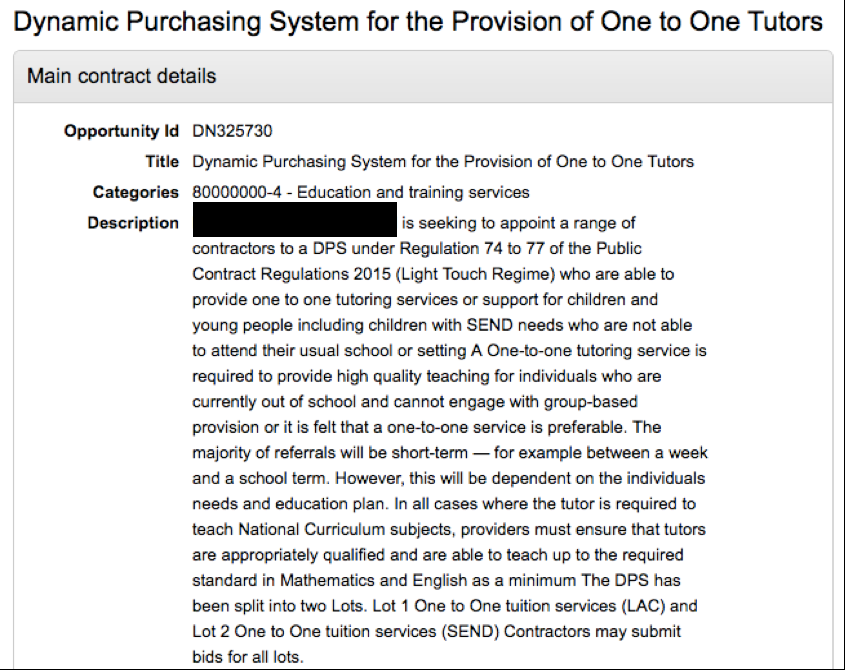
A recent example of this (from Feb 2018 – below) shows a DPS for the Provision of One-to-One Tutors.

CPV Codes
CPV Codes

Please also see ‘DPS – What is a Dynamic Purchasing System?’ for more information on this type of opportunity.

The buyer AND online portal in question have used the following code – 80000000-4 Education & Training Services, and probably unbeknownst to the buyer, there is a more specific code available for use – Tutorial Services 80590000-6. This is a prime example of how opportunities aren’t filtered across sub-sectors and are typically kept general and as a supplier (for let’s say ‘Business Enterprise Training’, who don’t offer 1-2-1 tutorials to children) you are either inundated with irrelevant opportunities or depending on what codes are used and which portals you are registered with (as not  websites use CPV coding) – receiving no opportunities at all.

Now, what if the buyer had only used the code Tutorial Services 80590000-6 and the supplier wasn’t receiving notifications due to them clicking an incorrect code upon sign-up or if the portal doesn’t use the CPV code option all at.

WE HOPE YOU’RE STILL WITH US!

It’s worthy to note that a contract for the ‘COLLECTION OF KEY QUALITATIVE AND QUANTITATIVE INFORMATION ON THE EUROPEAN COMMISSION’S MERGER DECISIONS’ was never awarded due to the code for ‘market research’ being used, when in fact, something more appropriate like the code for ‘economic research’ or ‘research services’ could have been used.

 This is where Tender Connect steps in.

We NEVER rely on CPV codes and through using procurement specialists, we filter through all opportunities in the Creative Sector across hundreds of notification platforms daily to ensure our customers receive the bespoke opportunities that apply to THEM!

The majority of national portals have electronic algorithms that scour and publish opportunities based on CPV codes alone, meaning a quarter of these are not being publicised as effectively as they can be.

With our services – If you are a website/digital agency, a design agency or an events management company, you’ll receive individual tenders that apply to you.

We also provide Full Service Agencies a range of opportunities that are specific to them too!


Please see our ‘Why use Creative Tenders’ blog for how this works in full.

Or for more information about our Creative Tenders portal CLICK HERE.

Don’t get put off by CPV codes.

We don’t use them!

We don’t need to!

Join the revolution!

WHAT IS A DYNAMIC PURCHASING SYSTEM? The DPS in Tendering!

WHAT IS A DYNAMIC PURCHASING SYSTEM? The DPS in Tendering!

Here we go again – another term which is not well known in all industry sectors across the UK – a Dynamic Purchasing System.

As always, we are here to help you understand all these ‘niggly’ bits to tendering, to ensure you are prepared to undergo some serious business development planning across your sector and beyond!

You can see the different bidding terminologies applicable in our ‘Tendering doesn’t have to be complicated’ blog. 

In a nutshell – a Dynamic Purchasing System (or DPS for short) is basically a supply chain list where tenders or other bidding opportunities are published to specific members that have been successful in maintaining a position on that list.

As quoted in the Public Contracts Regulations 2015, “[a] DPS should be set up for identified types of requirement, which may be divided into categories of products, works or services.”

This could be any organisation or group of organisations, who wants to outsource work in either one or more service areas [or LOTs] and rather than having 50-100 applications come through for the [potentially many] tenders they publish, they start by narrowing down a set-list of applicants onto their own DPS.

Differences between Dynamic Purchasing System & General Tender processes

The main differences from the typical tender process are that a DPS is to:

  • be run as a completely electronic process (no paper or posting required here)
  • allow new suppliers to join at any time (meaning that if you have been unsuccessful at securing a place – you can always try again in the future)
  • and show longevity in its run (we’ve come across DPS’s which are open for 10 or more years)

All that suppliers would need to do, is register their company onto this DPS online, click which service area they are interested in delivering and undergo a Stage 1 submission in order to secure a place. Once secured, Stage 2 is the actual tendering of the works in question.

For example – A Housing Association could create a DPS for their outsourced Creative activity, which includes a range of service areas/LOTs – i.e. Branding, Printing, Website Hosting etc. They would publish this DPS opportunity to all and then undergo multiple stages to narrow down the process of awarding the work via the ‘most economically advantageous tender’ (MEAT).

Stage 1

In the average UK tender process, a lot of suppliers may be asked to complete a Pre-qualification Questionnaire (PQQ) to help the buyer narrow down their list of Invitations to Tender (ITT). This is now being taking over by a ‘Selection Questionnaire’ on many portals. It’s similar with a DPS – the supplier has to get onto the DPS in order to be Invited to Tender for works and they do this by completing a Stage 1 application process that heavily resembles a PQQ, with maybe a few additional questions thrown in.

Like a typical PQQ-to-ITT process, securing access to the DPS reflects a ‘weed-out’ procedure, with the buyer ensuring they progress all applicants who demonstrate greater strengths in their financial, technical and professional capabilities.

Stage 2

Once you are successful and Stage 1 is complete – it is complete. You do not have to re-do any capability and competency-based questions. Every time a tender is published in relation to your service area, as part of this Dynamic Purchasing System, you are automatically invited to tender and answer all questions specific to that service!

Once on the DPS then a range of tenders will then ensue (as and when required), allowing the buyer to streamline a more technically-focused evaluation on the responses collated.

Where we stand in all of this!

Our Tender Connect platform, which will be launching within the next 12-months, has many traits of a Dynamic Purchasing System, in that a buyer, let’s, for example, say a Design agency on our Creative Tenders portal, seeks a professional company who can support their financial/accountancy needs. All that the Design agency would do is:

  • Log on to Tender Connect
  • View a list of our Professional Tenders subscribers, which encapsulates a large list of Accountancy firms
  • Publish their ‘private opportunity brief’ to a filtered list of suppliers
  • Receive responses, evaluate and award

The reason we filter this list is to avoid publishing opportunities that bare minimal relevance to our suppliers. And to streamline the process for our buyers, helping them publish specific competitive opportunities to the most competent suppliers.

So, if you ever come across a DPS that contains services specific to your offering – get on board.

Our Tender Consultants can help you succeed!

WE HAD TO GOOGLE THE VISION OF OUR OWN COMPANY! – Making sure you have consistent marketing messages!

WE HAD TO GOOGLE THE VISION OF OUR OWN COMPANY! – Making sure you have consistent marketing messages!

Businesses can often feel like they’re losing their way, especially when producing tender documents and relaying their ‘spirit’ and clear marketing messages across on paper. Competition is growing with the increase in entrepreneurial mindsets and innovating youngsters in Universities, who are now encouraged to master their talents and develop start-up new businesses with help from mentors and growth coaches.

For those of us who are already trading and focused on either sustaining or growing our businesses, we need to make sure we remain valid and innovative to stand the test of time and fulfil client requirements using innovative tools and techniques that make it easier for our buyers to use our services.

You wouldn’t be the first if you’d admit that you had to google the vision of your own company.  We all lose our way from time to time, but the most important thing is, that it remains consistent in the public eye. If you’re writing one thing in your tender documents but your website, marketing materials and employees are saying another, it only reduces the confidence that buyers have in your ability to deliver a consistent service.

Our vision…

We thrive on the vision of our Company – to become the next Billion-pound company to come out of the UK, and we plan to do that with our headquarters in County Durham. It’s a simple vision that no one in this company will ever forget. Yes, we have sub-ambitions about innovation and employee development, but they all work towards our billion-pound vision and we write it absolutely everywhere. It’s consistent, it’s daring and it’s a powerful message for anyone who wants to work with us.

The core focus of this article is to encourage consistency. If you do one thing after reading this article, try reading your website and your marketing materials and then ask each of your employees (separately) what they believe your vision is, mark a percentage of how many of them are right. From that, you can fix one thing today – you can ensure your team are working toward the same goal.

Standout by being consistent. Discover your vision to allow you to succeed when tendering. Procure the best and invest
in innovation.

We’re happy to help you ensure your vision and marketing messages are all conveyed clearly across
your Tendering efforts.

Get in touch with our Tender Consultants for more information!